Peak trading does not create operational problems. It exposes the ones your business has been able to absorb during normal trading.

A process that works comfortably in September can look very different when order volumes rise, promotions intensify, customers expect faster fulfilment and teams have less spare capacity to correct mistakes. For UK retailers, preparing for Q4 therefore involves more than forecasting demand and ordering enough stock. It means testing whether the operation can maintain availability, pricing accuracy, customer experience, fulfilment performance and control when pressure increases.
A practical retail audit guide should therefore ask a broader question: is the business ready to execute its commercial plans when demand is higher and operational slack is lower?
What Does Peak Readiness Actually Mean?
Peak readiness is often reduced to three things: having enough stock, enough people and enough warehouse capacity. Those are important, but they are only part of the picture. A retailer can have sufficient inventory and still lose sales because products are unavailable in the right locations. A promotion can generate strong demand while creating pricing errors or fulfilment pressure. A store can meet merchandising standards during a quiet period but struggle to maintain them when staff are dealing with queues and higher workloads.
This is why a retail audit guide should examine the complete retail operation rather than one department at a time. The aim is not to find a perfect operation. Few organisations have one. The aim is to identify where additional demand could create commercial leakage, customer friction, operational bottlenecks or compliance risk while there is still time to respond.
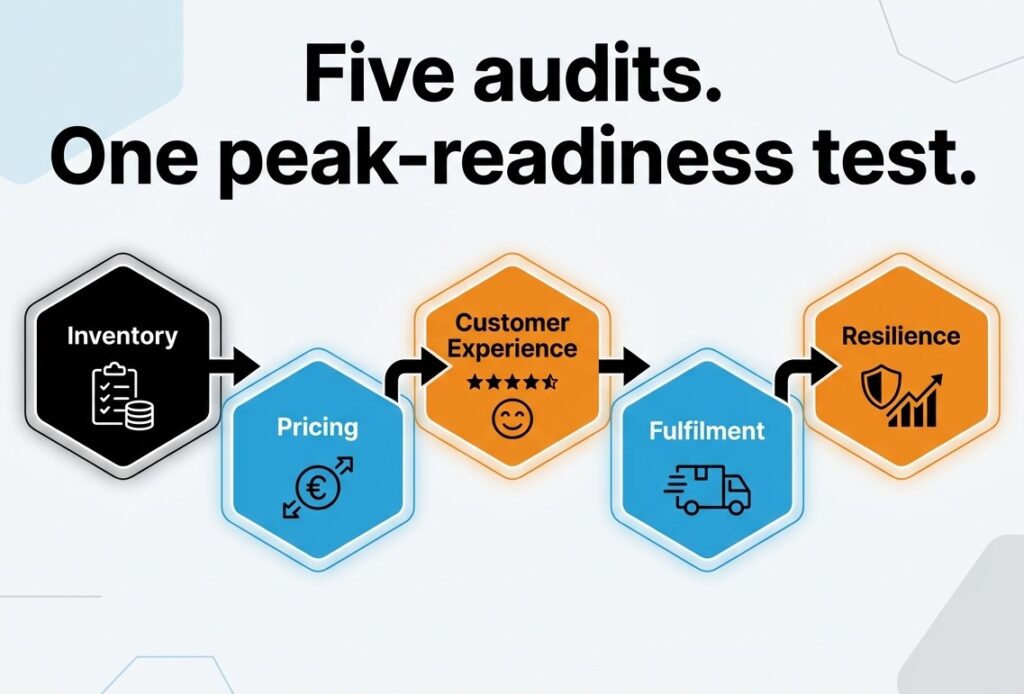
The following five audits provide a practical retail audit guide for doing that.
1. Inventory & Availability Audit
The first question is deceptively simple: can customers actually buy what you expect to sell? Inventory is not just a warehouse issue. It affects sales, customer experience, fulfilment, working capital and the ability to respond to changes in demand. A strong retail audit guide should examine whether stock records accurately reflect physical inventory and whether products are available through the channels where customers expect to find them.
Is the stock customers want actually available?
Start with the products that matter most. Look at top-selling SKUs, seasonal products and items expected to drive promotional activity. Compare system inventory with physical stock. Examine how quickly stock is replenished and whether there are recurring discrepancies between locations or channels. For omnichannel retailers, visibility becomes particularly important. Stock may exist somewhere in the network but still be unavailable to the customer because it is allocated incorrectly, awaiting movement or not visible through the relevant sales channel.
Where can availability break down?
A retail audit guide should look for recurring causes of stock outs and overstocks rather than simply recording that they occurred. Delayed replenishment, inaccurate inventory records, slow-moving stock occupying space and poor communication between stores, warehouses and digital channels can all reduce effective availability.
Consider measuring:
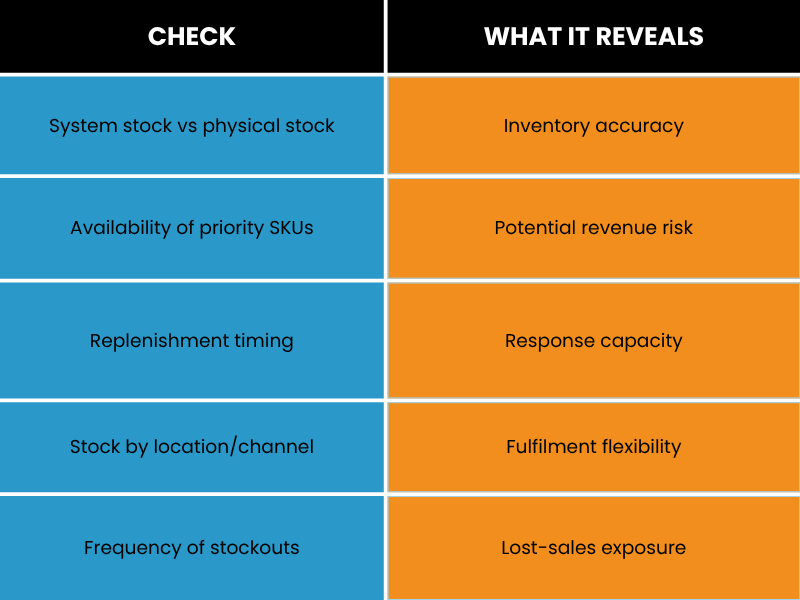
The objective is to identify whether inventory is genuinely supporting the sales plan or whether weaknesses in visibility and movement could become more significant during a retail peak period.
2. Pricing & Promotion Audit
Peak trading often comes with a heavier promotional calendar. That makes pricing accuracy and promotional execution just as important as the promotion itself. A campaign may be commercially well planned but still create problems if the offer is applied incorrectly, displayed inconsistently or supported by insufficient stock.
Are your promotions executing as planned?
Audit promotional prices across the customer journey. Check website pricing, point-of-sale systems, promotional signage, discount rules, bundles, multibuys and campaign start and end dates. Where multiple channels are involved, confirm that the customer receives the same offer wherever appropriate.
The retail audit guide approach should also test what happens when a promotional rule fails. Can staff identify the correct price? Is there a clear process for resolving disputes? Can pricing issues be corrected centrally, or does each location have to intervene manually? These details matter because even relatively small pricing discrepancies can create customer frustration and margin leakage at scale.
Are you protecting margin as well as conversion?
Promotions are designed to increase demand, but the commercial outcome depends on more than sales volume. Incorrect discounts, unnecessary price overrides or poorly controlled promotional mechanics can reduce the margin generated by additional sales. During a retail peak period, the sheer number of transactions can make small errors more expensive. Leaders should therefore audit promotional execution alongside promotional performance, as per retail audit guide.
The key question is not simply whether the campaign attracted customers. It is whether the organisation can deliver the campaign accurately, consistently and profitably.
3. Merchandising & Customer Experience Audit
Customers experience the retail operation through what they can see, find, buy and understand. That makes merchandising and customer experience another critical audit area. A retail audit guide should test whether the intended customer experience is actually being delivered at store and digital level.
Does the customer see what you intended them to see?
For physical retail, examine planogram compliance, product placement, signage, promotional displays and seasonal merchandising. For digital channels, consider product imagery, descriptions, availability information, navigation and promotional presentation. The distinction between planned and executed experience matters. Head office may create a carefully designed campaign, but customers interact with the version that actually appears in the store or online. A display that is incomplete, incorrectly positioned or poorly maintained can weaken the impact of the wider campaign.
Is the customer journey creating friction?
The retail audit guide should also follow the customer beyond product discovery. Look at checkout, queues, click and collect, returns information, customer queries and staff availability. Consider whether these areas remain manageable when traffic increases. Peak pressure can expose problems that are barely noticeable during normal trading. A customer who normally receives immediate assistance may have to wait. A click-and-collect process that works for a few orders may struggle when volumes increase. A returns process may create a backlog after promotional activity.
The goal is not simply to measure satisfaction. It is to identify where customer experience depends on operational capacity that may not exist during peak.
4. Operations & Fulfillment Audit
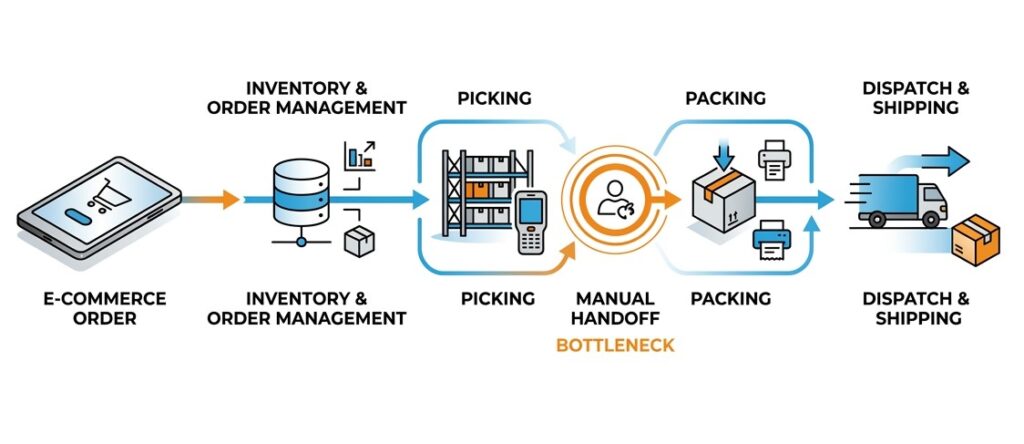
This is where peak readiness becomes a direct question of operational capacity. Can the business process, fulfill and support a significantly higher volume of transactions without creating unacceptable delays, rework or manual intervention?
Can your operation absorb more orders?
Map the journey from order capture through inventory confirmation, picking, packing, dispatch, carrier hand-off and customer communication. Then look beyond the obvious warehouse steps.
How much work happens between systems? How many orders require manual checking? How are exceptions handled? How quickly can teams identify and resolve issues?
A useful retail scalability audit should distinguish between activity and capacity. A team may process thousands of orders every day, but that does not necessarily mean it can absorb another thousand without disproportionate additional effort.
Where are the bottlenecks hiding?
Bottlenecks often sit between departments rather than inside them. A warehouse may have sufficient picking capacity, but delayed inventory information can prevent orders from moving. Customer service may have enough staff, but recurring fulfilment exceptions can overwhelm the team. Finance may have suitable systems, but manual reconciliation can create an administrative backlog. This is where workflow design becomes important.
For example, if employees repeatedly copy information between systems, chase approvals through email or manually reconcile records, additional transaction volume can increase workload faster than revenue. Rather than automatically adding people, leaders should first understand which process constraints are consuming capacity. That is the practical purpose of a retail scalability audit: identifying whether growth is being supported by a scalable operating model or by increasing amounts of manual effort.
For enterprise organisations, this distinction becomes particularly important because small inefficiencies can become significant when multiplied across locations, channels and transaction volumes.
5. Compliance, Controls & Resilience Audit
The final audit asks whether the organisation can maintain control when normal operating conditions change. This includes compliance, safety, loss prevention, financial controls, operational procedures and business resilience.
Are your controls ready for peak?
Review the procedures that protect the business and its customers. Depending on the operation, this can include health and safety procedures, cash and point-of-sale controls, returns and refund processes, loss prevention, warehouse standards, required documentation and staff procedures. A retail audit guide should not treat these checks as paperwork exercises. The important question is whether the control works in practice when teams are under pressure. A process that depends on everyone having plenty of time may not be a robust process.
What happens when something goes wrong?
Resilience is also about what happens outside the standard workflow. If a key system becomes unavailable, who takes ownership? If an experienced employee is absent, can another person follow the process? If an unusual customer issue arises, is the escalation route clear?
Retail operations often depend on experienced employees knowing how to resolve exceptions. That knowledge is valuable, but it can also become a hidden dependency. The answer is not to automate every decision. It is to make processes, ownership, information and escalation routes sufficiently clear that the organisation can continue operating when individuals are unavailable. This is particularly important before peak because higher demand reduces the spare capacity available to compensate for unclear processes.
What These Five Audits Tell You About Peak Readiness
The five audits are most useful when viewed together rather than as isolated checks.
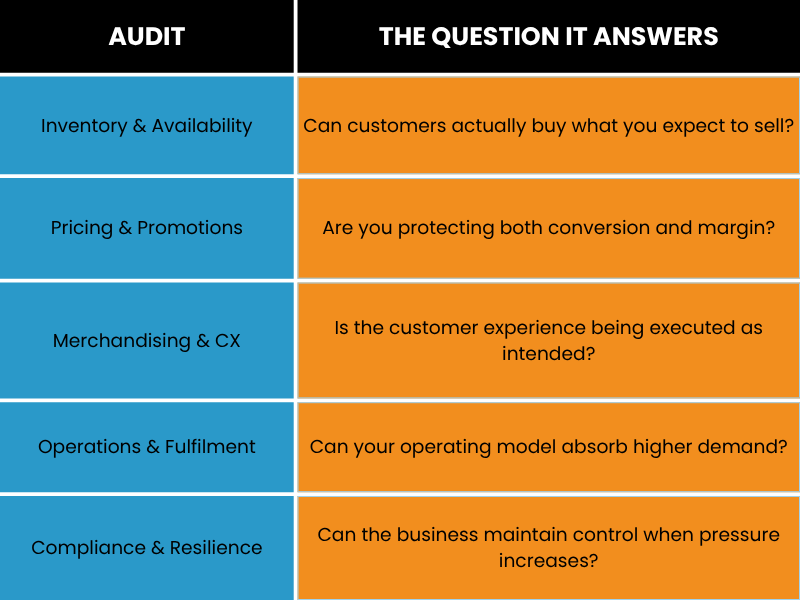
The connections between these areas are where some of the most important risks appear. A successful promotion can increase demand. Increased demand can put pressure on stock availability. Higher order volumes can increase fulfilment exceptions. Those exceptions can generate additional customer-service work. Higher workload can make it harder for teams to maintain controls. In other words, one weakness can create pressure somewhere else.
That is why a UK retail guide focused only on individual departments can miss the bigger picture. Peak readiness is ultimately about how the parts of the operation work together.
The Real Value of an Audit Is What You Do With the Findings
An audit should not end with a list of red, amber and green boxes that disappears into a planning folder. Each significant finding should lead to a clear decision. ,The retail audit guide approach should therefore priorities findings based on commercial and operational impact.
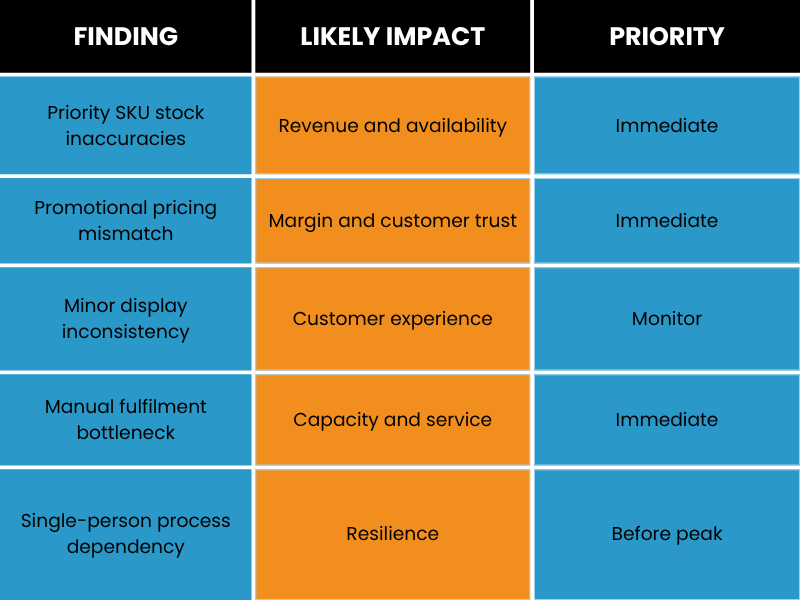
This turns auditing from a compliance exercise into a decision-making tool.
Don’t Wait for Peak to Find the Gaps
Peak does not create operational weaknesses. It exposes them. A stock discrepancy becomes a missed sale. A manual hand-off becomes a delay. A process that depends on one person becomes a bottleneck when demand rises. The purpose of these five audits is simple: find those pressure points before Q4 does.
Because the real question is not whether your operation works at normal volume. It is whether it can handle more without everything else becoming harder.
Find the bottlenecks before peak finds them for you.
Join the upcoming live masterclass with we.simplify to turn peak-readiness gaps into practical operational improvements.