Imagine getting back two hours of your working day without hiring another employee. For many businesses, those hours are lost to repetitive admin tasks like copying data, sending follow-up emails, updating spreadsheets, and creating reports. The good news is that these tasks don’t have to stay manual.
With today’s automation tools, businesses of every size can streamline routine work and focus on activities that actually drive growth. While these jobs are necessary, completing them manually every day reduces efficiency and increases the risk of mistakes.
Learning how to automate repetitive tasks is no longer reserved for large enterprises with dedicated IT departments. Thanks to affordable cloud software and no-code automation platforms, businesses of all sizes can streamline routine operations, improve customer service, and increase productivity without significant technical expertise.
In this guide, you’ll discover how to automate repetitive tasks through ten practical examples that businesses can implement today.
Why Automating Repetitive Tasks Matters
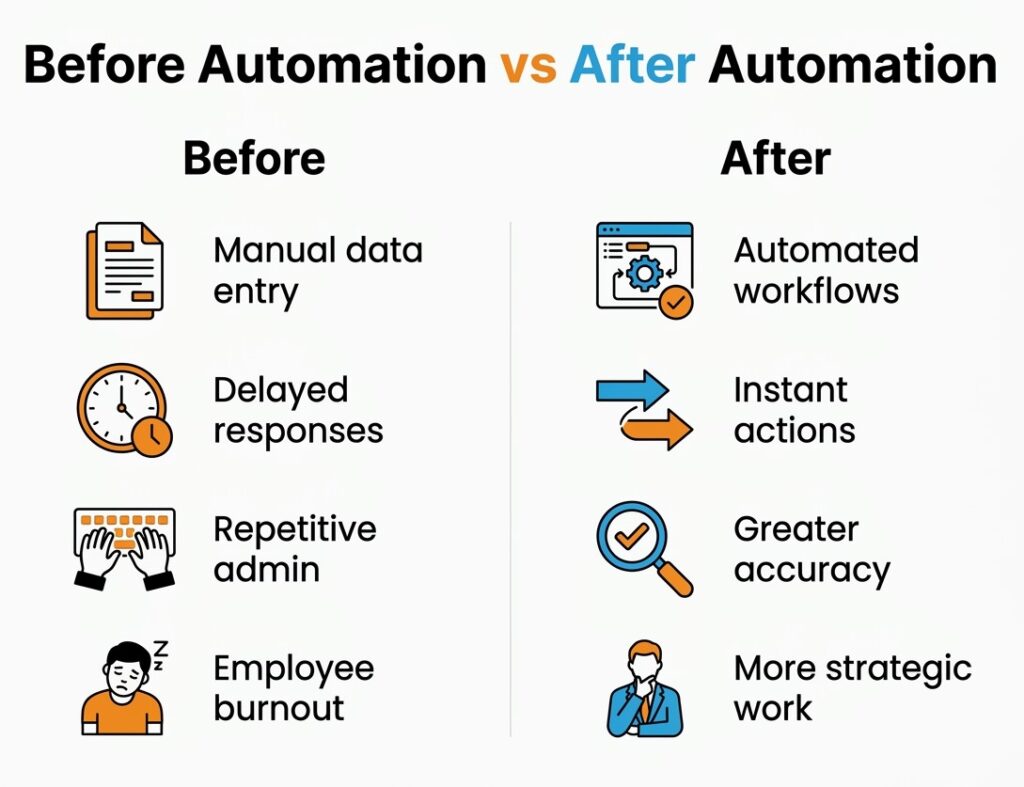
Manual processes cost organizations more than just time. They increase the likelihood of human error, create inconsistencies, and contribute to employee burnout by forcing staff to spend hours on low-value administrative work instead of activities that require creativity and decision-making. According to the UK’s Office for National Statistics, improving digital adoption remains one of the biggest opportunities for increasing business productivity, particularly among small and medium-sized businesses. Industry research from McKinsey also suggests that around 60% of occupations contain tasks that could be at least partially automated using existing technologies. For businesses unsure where to begin, a workflow assessment can quickly identify repetitive processes that deliver the fastest return on investment. This is where specialists like we.simplify help organizations priorities automation opportunities instead of trying to automate everything at once.
Understanding how to automate repetitive tasks allows businesses to achieve consistent time savings, improve accuracy, and create scalable repetitive workflows that continue running with minimal supervision.
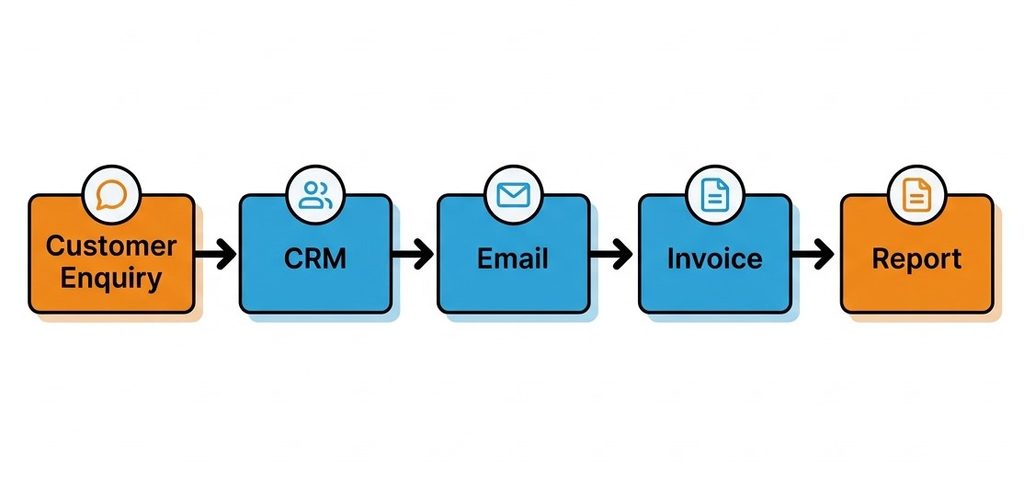
10 Real Examples of Repetitive Tasks You Can Automate
1. Customer Enquiries
Businesses often receive the same questions every day about pricing, opening hours, delivery, or services. AI chat bots and automated help desks can answer common enquiries instantly while forwarding complex issues to a member of staff. This reduces response times and ensures customers receive support even outside working hours. Learning how to automate repetitive tasks like customer enquiries allows your team to focus on solving more valuable customer problems.
2. Appointment Scheduling
Manual appointment booking frequently involves lengthy email exchanges and double bookings. Modern scheduling platforms synchronize with calendars and automatically display available time slots. Customers can book appointments themselves, while the system sends confirmations, reminders, and follow-up emails automatically. These solutions rely on simple triggers and actions, ensuring every booking follows the same workflow without staff intervention.
3. Invoice Creation and Payment Reminders
Creating invoices individually and chasing overdue payments can quickly become an administrative bottleneck, particularly when finance teams are managing a high volume of transactions. Automation can generate invoices when work is completed, send payment reminders before due dates, and notify finance teams when invoices remain unpaid.
Many task automation tools integrate directly with bookkeeping and accounting systems, keeping routine invoicing activity moving without constant manual intervention. By taking repetitive finance administration off employees’ plates, businesses can free up more time for high-value client work, relationship management, and other activities that have a direct impact on growth.
4. Lead Capture and CRM Updates
Sales teams often waste valuable time copying customer information from website forms, emails, or other sources into CRM systems. Automation can remove this manual step by automatically creating customer records, assigning leads to the right salesperson, updating relevant fields, and triggering an initial response. Businesses exploring how to automate repetitive tasks often begin with lead management because it delivers immediate efficiency gains.
The real advantage is that automation can work with the core CRM tools a business already relies on, rather than adding another disconnected platform to the technology stack. By connecting website forms, CRM systems, sales tools and other applications, customer information can move automatically between systems, creating a more streamlined and reliable workflow. we.simplify helps businesses integrate these systems so automation strengthens their existing tech stack instead of requiring organizations to replace it.
5. Email Follow-ups
Following up with prospects manually can lead to inconsistent communication, particularly when sales teams are managing multiple enquiries at different stages. Automated email sequences allow businesses to send relevant messages after enquiries, purchases, downloads, or other customer interactions without employees having to remember every follow-up.
Today’s automated workflow tools for scaling manual tasks can personalise these sequences based on customer behaviour, timing, previous interactions, and where someone is in the buying journey. This means businesses can scale communication across a larger customer base while maintaining the high-touch, relevant experience that target customers expect. Instead of replacing personal communication, automation handles the predictable follow-ups so teams can spend more time on conversations that genuinely require a human touch.
6. Social Media Scheduling
Publishing content manually every day interrupts productive work. Scheduling platforms enable businesses to prepare weeks of content in advance, automatically publishing posts across multiple social media channels at optimal times. This creates consistent marketing activity while freeing employees to focus on creating higher-quality content rather than posting it.
7. Employee Onboarding
New employees often complete the same paperwork, receive identical training materials, and require similar system access. Automated onboarding workflows distribute contracts, collect digital signatures, assign training modules, and notify managers when each step has been completed. Many organizations use business process automation services to standardise onboarding while improving the overall employee experience.
8. Document Approvals
Approving purchase orders, contracts, or internal requests through email often causes delays. Workflow automation platforms route documents automatically to the appropriate decision-makers, send reminders for pending approvals, and maintain complete audit trails. Understanding how to automate repetitive tasks in document management reduces bottlenecks while improving accountability. If approval processes involve multiple departments, working with automation experts like we.simplify can ensure workflows remain efficient, compliant, and easy to scale as your business grows.
9. Inventory and Stock Alerts
Retailers and manufacturers often discover inventory shortages only after customers attempt to place orders. Inventory systems can monitor stock levels continuously and automatically generate alerts or purchase orders when products reach predefined thresholds. This reduces stockouts while helping businesses maintain healthy inventory levels without constant manual monitoring.
10. Reporting and Data Collection
Creating weekly or monthly reports manually often requires collecting information from multiple systems before compiling spreadsheets. Business intelligence platforms automatically gather data, update dashboards, and distribute reports on scheduled dates. Managers receive real-time insights instead of waiting for someone to prepare them manually. For many organizations learning how to automate repetitive tasks, automated reporting delivers some of the quickest returns because it removes hours of repetitive administration every week.
How to Choose the Right Tasks to Automate
Not every process should be automated immediately. Businesses achieve the best results by identifying activities that are repeated frequently, follow consistent rules, and require little human judgement. If employees repeatedly copy information between systems, send identical emails, approve routine requests, or generate recurring reports, these processes are excellent automation candidates. Businesses don’t need to automate every process overnight. we.simplify recommends starting with one high-impact workflow, measuring the results, and expanding automation gradually for sustainable growth.
When evaluating how to automate repetitive tasks, begin with one workflow that consumes significant time, measure the results, then expand gradually. Modern no-code automation platforms make it easier than ever to connect different business applications without extensive software development.
Common Mistakes to Avoid
- Automating inefficient processes without improving the workflow first.
- Using too many disconnected tools that create unnecessary complexity.
- Ignoring employee training, leaving teams unsure how automated workflows operate.
- Failing to monitor automations regularly, which can allow errors to go unnoticed.
- Trying to automate everything at once instead of starting with high-impact, repetitive tasks.
Build a Smarter Business Through Automation
Businesses no longer need expensive enterprise software to eliminate repetitive manual work. Affordable automation platforms now allow organizations of every size to streamline daily operations, improve consistency, and increase productivity without major technical barriers. Whether you begin by automating appointment scheduling, invoice processing, customer enquiries, or reporting, each improvement creates cumulative time savings while reducing human error and repetitive administration.
The most successful organizations do not automate everything at once. Instead, they identify one high-impact process, optimise it, and gradually expand automation across the business. By understanding how to automate repetitive tasks, companies can build more efficient operations, reduce employee burnout, and create sustainable growth without simply adding more manual work as they scale. Whether you’re automating one repetitive task or redesigning entire business processes, the right strategy makes all the difference. we.simplify helps businesses develop practical automation solutions that fit existing operations without unnecessary complexity.
Ready to streamline your operations? Discover tailored automation solutions that help your business save time, reduce manual work, and scale with confidence.